Saturday, January 17, 2015

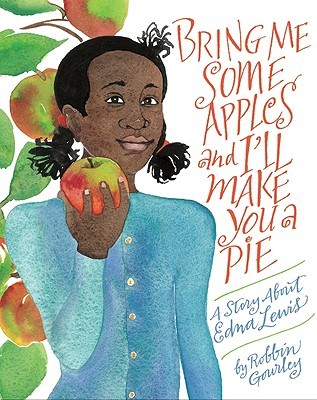
Bring Me Some Apples and I'll Make You a Pie

Bring Me Some Apples and I'll Make You a Pie: A Story About Edna Lewis

Gourley, R. (2009). Bring Me Some Apples and I'll Make You a Pie. New York: Clarion Books.

Readability lexile: AD810L

Adult Directed - Picture books often get an AD or "Adult Directed" code. They're usually read to a child, rather than a child reading them independently. Although seemingly easy reading, some picture books actually have pretty high Lexile measures, and could present a challenging independent reading experience to an age-appropriate reader. Initially, an adult may want to read the book along with the child.

Summary:

Long before the natural-food movement gained popularity, before green markets sprouted across the United States, Edna Lewis championed purity of ingredients, regional cuisine, and the importance of bringing food directly from the farm to the table. She was a chef when female chefs - let alone African American female chefs - were few and far between, and she received many awards for her work.

With lyrical text and beautiful watercolor illustrations, author/illustrator Robbin Gourley lovingly traces the childhood roots of Edna's appreciation for the bounties of nature. The story follows Edna from early spring through the growing season to a family dinner celebrating a successful harvest. Folk rhymes, sayings, and songs about food are sprinkled throughout the text, and five kid-friendly recipes and an author's note about Edna's life are included at the end. 

Evaluation of the text based on Donna Norton's characteristics of high quality literature (Norton, D. (2011):

This book could be used as high quality literature, because it serves for multiple avenues of learning. For example, this book could be used to teach about natural-foods. This book could also be used to teach about the seasons and harvest. 

In the Ten Steps for Reviewing Children's Literature by Norton, I think this book addresses illustrations the best. Gourley traced Edna's childhood roots of appreciation for the bounties of nature. I thought they were very colorful and eye-catching. 

Literary Elements:

1. Tone: Happy; Appreciation; Devotion; Dedication. 

2. Theme: With the change in seasons, there were different crops to be harvested.

3. Characters: Edna and her family members.

Mini-Lesson:

The lesson I would teach would be about the different seasons and about harvesting different crops during those seasons. I would have my students research which crops are grown during which seasons the best and why. They could also do further research on the crops that Edna harvested in the book. 

Target Audience: Juvenile Audience


My personal reaction to this book was that I really liked it. I thought Edna was portrayed as someone who really puts a lot into what she does and truly enjoys doing. I have to give her credit for not only being a female chef, but an African American female chef, at that. I thought that the author's note at the end of the book was a great touch. I also thought that the kid-friendly recipes were cute too. 

Home of the Brave


Applegate, K. (2007). Home of the Brave. New York: Feiwel and Friends.

Readability lexile: N/A

Summary:

Kek comes from Africa where he lived with his mother, father, and brother. But only he and his mother have survived. Now she's missing, and Kek has been sent to a new home. In America, he sees snow for the first time, and feels its sting. He wonders if the people in this new place will be like the winter - cold and unkind. But slowly he makes friends: a girl named Hannah in foster care, an old woman named Lou with a rundown farm, and a sweet, sad cow he names Gol that reminds him of home. As he waits for word of word of his mother's fate, Kek weathers the tough Minnesota winter by finding warmth in his new friendships, strength in his memories, and belief in his new country.

Evaluation of the text based on Donna Norton's characteristics of high quality literature (Norton, D. (2011):

This book could be used as high quality literature, because it serves for multiple avenues of learning. For example, it does a great job of showing just how difficult it is for someone who comes from a war torn country. This book could also be used to explain how someone adapts to a new way of life. 

In the Ten Steps for Reviewing Children's Literature by Norton, I think this book addresses the story line the best. It follows a young boy and his struggle to make his way in a new country. Kek and his family in Minnesota live in poverty, but are portrayed non-stereotypical. 

Literary Elements:

1. Setting: Mainly in Minnesota. Kek does have flashbacks from time to time of Africa, also.

2. Theme: Patience and Hope. Hope is a thing only made for people, a scrap to hold onto in darkness and in light. But hope is hard work. 

3. This book is written in a poetic, free verse format. 

Mini-Lesson:

The lesson I would teach would be about hope. Kek has incredible hope that soon he will be reunited with his mother. I would instill in my students that they should never lose sight of light, when all seems to be dark. Kek never once said that he was going to give up. 

Target Audience: Grades 6-8


My personal reaction to this book was that I thoroughly enjoyed it. I did not think that I would be enjoy it based on the cover, but it goes to show you that you cannot judge a book by its cover. 

I thought the format of the book made it easier to read. Even though it was easy enough to read, it does not mean that the words were easy to digest. There were moments when reading I would have to take a minute ans digest it all.  

Thursday, January 15, 2015

Arthur's Mystery Envelope


Brown, M. (1998). Arthur's Mystery Envelope. Boston: Little, Brown and.

Readability lexile: 370L

Summary:

When Mr. Haney, the principal, asks Arthur to bring home a mysterious brown envelope marked "private" and "confidential," Arthur can't help but wonder what's inside. His friends Buster, Francine and Muffy all take guesses: what if it's a note about a failing grade? Or a lost library book? Or - terror of all terrors - a letter saying Arthur has to attend summer school!

By the time he arrives home from school Arthur is racked with worry. He figures bad news won't be so bad if his mother never reads it, so he doesn't tell her when he sees the envelope accidentally fall into the wastebasket. Arthur finally learns a gentle lesson about telling the truth and facing his fears, but you'll have to find out for yourself what was in the mysterious brown envelope.

Evaluation of the text based on Donna Norton's characteristics of high quality literature (Norton, D. (2011):

This book could be used as high quality literature, because it serves for multiple avenues of learning. For example, it could be used to teach the lesson about telling the truth and facing your fears. Even if it is something bad, it is important to get someone involved so they can help. Putting off bad news doesn't make it get any better. Sometimes it can actually make it worse. 

In the Ten Steps for Reviewing Children's Literature by Norton, I think this book addresses the power of the book. The words and images in the book had the ability to nurture or undermine sense of self, and it deeply impacted attitude. 

Literary Elements:

1. Characters: Arthur, Mr. Ratburn, Miss Sweetwater, Francine, Buster, Sue Ellen, Muffy, Binky, Brain, Miss Tingley, Mr. Haney, Mr. Read, Mrs. Read, D.W., and Kate.

2. Conflict: Arthur had to comes to terms with telling the truth and facing his fear of the private, confidential envelope. 

3. Tone: Scared; Worried; Relief.

Mini-Lesson:

I would use this book to teach about telling the truth and overcoming fears. I would use Arthur's example as one to get students thinking about the importance of telling the truth and also fears that they have. I would have students create strategies to help them overcome their fears. 

Target Audience: Grades 3-5


My personal reaction to this book was that I thought it was very suitable for my reading buddy. He is in the third grade and is just beginning to read chapter books. Growing up, I used to love reading Marc Brown books and watching the Arthur shows on TV. I thought my reading buddy would also get the same joy and adventure out of the book as much as I did at his age. I also thought the story line was very relevant to his age.

Wednesday, January 14, 2015

Tadpole's Promise


Willis, J., & Ross, T. (2005). Tadpole's Promise. New York: Atheneum Books for Young Readers.

Readability lexile: AD400L

Adult Directed - Picture books often get an AD or "Adult Directed" code. They're usually read to a child, rather than a child reading them independently. Although seemingly easy reading, some picture books actually have pretty high Lexile measures, and could present a challenging independent reading experience to an age-appropriate reader. Initially, an adult may want to read the book along with the child. 

Summary:

Where the willow tree meets the water, a tadpole met a caterpillar. They gazed into each other's tiny eyes and fell in love. He is her "shiny black pearl," and she is his "beautiful rainbow." "I love everything about you," said the caterpillar. "Promise you'll never change." And foolishly, the tadpole promised. But we all know that tadpoles don't stay the same, and neither do caterpillars. 

When they next meet, he has sprouted two legs. She forgives him, but after he breaks his promise twice more and now looks more like a frog than her "shiny black pearl," the lovelorn larva ends the affair and cries herself to sleep. Meanwhile, the melancholy frog sulks around the pond, making heart-shaped air bubbles that rise to the surface and burst. When the caterpillar awakens, now a butterfly, she decides to forgive her beloved and flies about the water to find him. She is not even able to complete the sentence, "Have you seen my shiny black?" when, without a thought, the frog swallows her whole, and then returns to wondering about whatever happened to his "beautiful rainbow."

Evaluation of the text based on Donna Norton's characteristics of high quality literature (Norton, D. (2011):

This book could be used as high quality literature, because it serves for multiple avenues of learning. For example, this is a wonderful story to use to introduce, or reinforce, the concept of life cycles. However, this may not be suitable for younger children. I would recommend maybe fifth grade or older. Although the ending is a wonderful and certainly realistic twist, it might be a bit harsh for younger children. 

This book could also be used to teach a moral lesson in teaching children to be careful of what kinds of promises they make. Things change and we cannot expect them to stay the same. 

In the Ten Steps for Reviewing Children's Literature by Norton, I think this book addresses relationships. This book talks about the relationship between the tadpole and the caterpillar. 

Literary Elements:

1. Setting: Where the willow tree meets the water.

2. Theme: Trying to keep a promise.

3. Conflict: A tadpole and a caterpillar promise each other something that is unattainable. 

Mini-Lesson:

I would review with my students the life cycles of frogs and butterflies. I would talk about metamorphosis and the various stages of development. If I needed to, I would re-read the book and highlight the various stages. 

Target Audience: Grades 3-6


My personal reaction to this book was I thought it started off as sweet and then I was suddenly surprised the route it ended up taking. I would have to say it is not the most cheerful children's book, but I think it does teach a valuable lesson.  

Esperanza Rising

Esperanza Rising

Ryan, P. (2000). Esperanza Rising. New York: Scholastic Press.

Readability lexile: 750L

Summary:

Esperanza thought she'd always live with her family on their ranch in Mexico - she'd always have fancy dresses, a beautiful home, and servants. But a sudden tragedy forces Esperanza and Mama to flee to California during the Great Depression, and to settle in a camp for Mexican farm workers. Esperanza isn't ready for the hard labor, financial struggles, or lack of acceptance she now faces. When their new life is threatened, Esperanza must find a way to rise above her difficult circumstances - Mama's life, and her own, depend on it. 

Evaluation of the text based on Donna Norton's characteristics of high quality literature (Norton, D. (2011):

This book could be used as high quality literature, because it serves for multiple avenues of learning. For example, in the back of the book there are discussion questions that can be discussed among the class. These questions are great conversation starters and usually lead to pretty successful outcomes. This book could be used to teach about the Great Depression. This book could also be used to teach about trying to walk in someones shoes. 

In the Ten Steps for Reviewing Children's Literature by Norton, I think this book addresses a hero and that is Esperanza. Though she struggled with coming to terms that her life is now different that her Papa died, she became an incredible young woman. I think for young readers, they will captured by Esperanza's never ending spirit and never be afraid of starting over. 

Literary Elements:

1. Setting: Aguascalientes, Mexico; Arvin, California.

2. Tone: Riches to rags; Uncomfortable; Strength; Love; Adventure.

3. Characters: An array from young to old Mexicans.

Mini-Lesson:

I would use this book to have an in depth discussion with my students on whether or not that have been in a situation where they had to leave somewhere out of their comfort and had to go somewhere where they were made uncomfortable. I would lead the discussion further by asking how it made them feel and what it was like for them. I would bring closure to the lesson by leaving them with the question, "How can we help others adjust to new situations if we knew we had been through something similar?" 

Target Audience: Grades 3-7


My personal reaction to this book was that even though the book did not have any illustrations, the words painted such a vivid picture in my head that really stood out. The author's choice of words made the chapters come alive and I felt as if I was right there with Esperanza. It was a book I found hard to put down and touched my heart. 

Friday My Radio Flyer Flew

Friday My Radio Flyer Flew

Pullen, Z. (2008). Friday My Radio Flyer Flew. New York: Simon & Schuster Books for Young Readers.

Readability lexile: N/A

Summary:

What do you do with an old red wagon?

Well, that depends. If the wagon in question is a an old Radio Flyer discovered while exploring the attic with your dad, and if you have a passion for flying machines, then you may have just found the perfect way to get your dreams off the ground. 

Evaluation of the text based on Donna Norton's characteristics of high quality literature (Norton, D. (2011):

This book could be used as high quality literature, because it serves for multiple avenues of learning. For example, this book could be used to teach about the process of repairing something. This book could also be used to teach about relationships. 

In the Ten Steps for Reviewing Children's Literature by Norton, I believe this book addresses the relationships between people. In this book, it is a father and son who find the old Radio Flyer wagon when cleaning out the attic, and through the course of a week, turn in back into a wonderful toy. 

Literary Elements:

1. Characters: A father and son.

2. Theme: Taking an old Radio flyer wagon and in the course of a week, transforming it into a wonderful toy.

3. Tone: Pure joy and happiness of a father and son who come together to create a wonderful toy.

Mini-Lesson:

The lesson I would teach would be about relationships. I would ask students who they have a good relationship with, whether it be mom or dad, grandma or grandpa, or even a pet. I would then have students write about that relationship and what it is that makes the relationship work.

Target Audience: Grades P-2


My personal reaction was that I really enjoyed the illustrations. I thought they were eye catching. I also enjoyed the simplicity of the story line. I can easily relate to the boy in the book in that he has a strong relationship with his father. I have a strong relationship with my mother and we do all kinds of things together. I would hope that if I used this book in my classroom that my students would be able to tell me about a good relationship they have, even if it is not their father. 

Wanda's Roses


Brisson, P., & Leffler, M. (1994). Wanda's Roses. Honesdale, Pa.: Caroline House, Boyds Mills Press ;.

Readability lexile: AD740L

Adult Directed - Picture books often get an AD or "Adult Directed" code. They're usually read to a child, rather than a child reading them independently. Although seemingly easy reading, some picture books actually have pretty high Lexile measures, and could present a challenging independent reading experience to an age-appropriate reader. Initially, an adult may want to read the book along with the child. 

Summary:

When Wanda discovers a thorn bush growing in an empty lot, she's quite sure it's a rosebush ready to bloom. So she clears away the trash, checks on it every day, and brings water from the butcher shop across the street. But no roses appear. Wanda's neighbors and friends are all doubtful, but when she invites them to a tea party in her "rose garden" one day in June, they're in for a big surprise. 

Evaluation of the text based on Donna Norton's characteristics of high quality literature (Norton, D. (2011):

This book could be used as high quality literature, because it serves for multiple avenues of learning. For example, this book could be used to teach about helping the environment. This book could be used to teach about how to support someone in something they believe in, such as Wanda's neighbors believing she could turn her "rosebush" into something beautiful. This book could also be used to talk about talents and how it takes tremendous amounts of determination to become successful.

In the Ten Steps for Reviewing Children's Literature by Norton, I think this book addresses the relationships between people. Wanda had wonderful relationships with her neighbors and Wanda really admired them, as much as they admired her.

Literary Elements:

1. Setting: Empty corner lot at Fillmore and Hudson.

2. Theme: Gardening; Determination; Perseverance; Neighborhood Life; Friends and Friendships.

3. Tone: The reader gets wrapped up into Wanda's determination to make her "rosebush" grow and the strong relationships she shares with her neighbors. 

Mini-Lesson:

The lesson I would teach would be about the environment. I would talk about the importance of taking care of our environment and what it takes to make something grow. I would have students decide on what they would like to grow as a class and record what it takes have something grow successfully.

Target Audience: Grades K-2


My personal reaction to this book was that I really enjoyed the illustrations. I thought they were well done and I really enjoyed the story line. I think it would easily grab the attention of a young reader.